

Bail Applications in NSW Courts
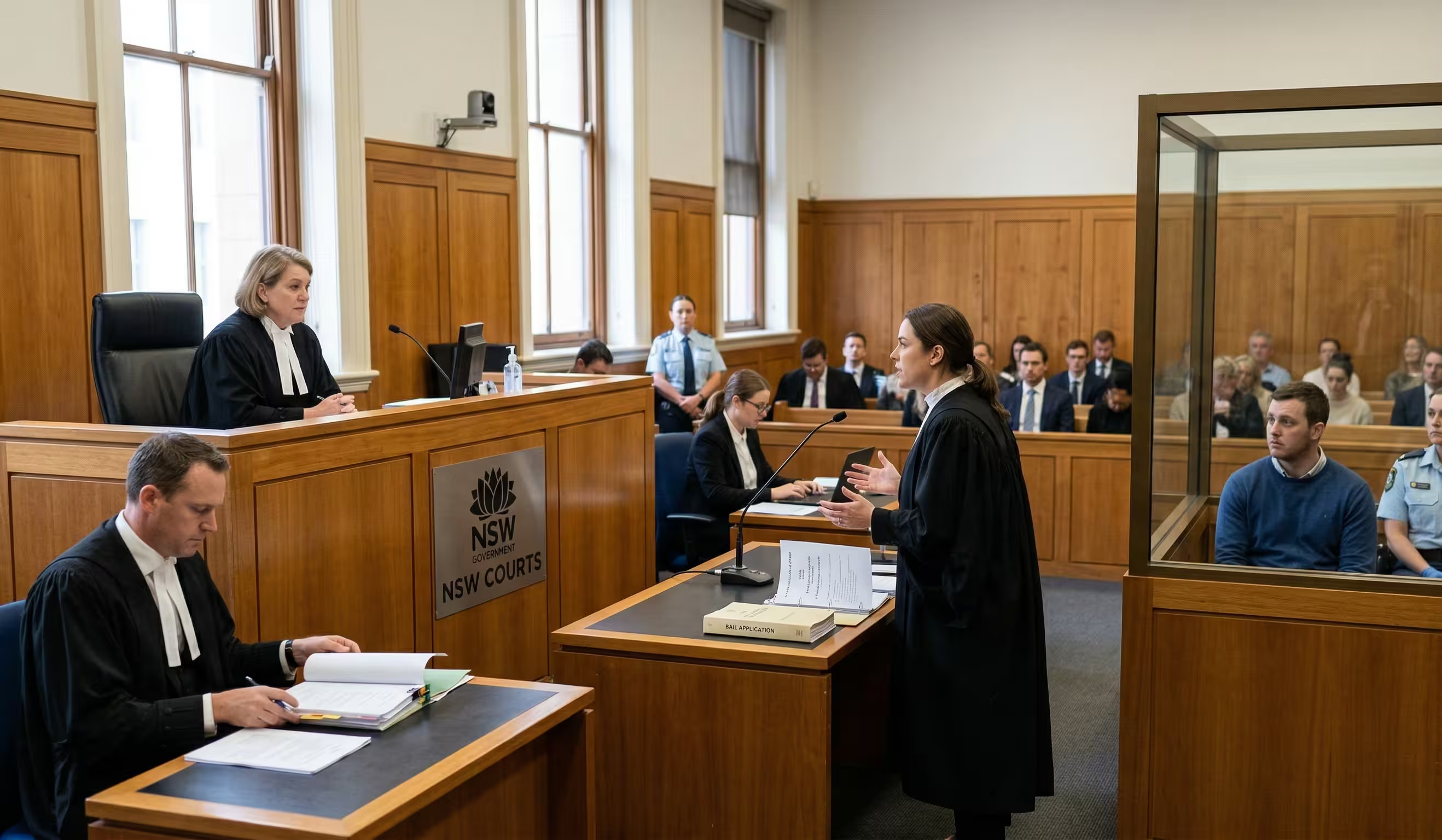
Bail Applications in NSW Courts (Local, District, Supreme Court)
Introduction
Bail is the conditional release of an accused person awaiting trial. The Bail Act 2013 (NSW) governs this process, establishing a framework that balances the presumption of liberty against the need to protect the community and ensure court attendance. The court hierarchy—Local, District, and Supreme—determines where a bail application is heard, and the complexity increases with the severity of the charge.
The Test for Bail
The court must assess "unacceptable risk." The prosecution does not have to prove the accused is guilty; they must prove there is an unacceptable risk that the accused will:
- Fail to appear in court.
- Commit a serious offence while on bail.
- Endanger the safety of victims, witnesses, or the community.
- Interfere with witnesses or evidence.
If the prosecution proves an unacceptable risk, bail is refused. If not, the court must grant bail, with or without conditions.
Show Cause Requirement
For Show Cause Offences (serious crimes like murder, large-scale drug supply, certain terrorism offences), the accused bears the burden of proving why their detention is not justified. This is a high threshold.
Levels of Bail Applications
1. Local Court (The First Instance)
The Local Court hears most standard bail applications.
- Process: Usually occurs at the "first mention" or during a weekend "arrest court."
- Who applies: Police prosecutor vs. Defence solicitor.
- Outcome: The magistrate can grant bail with conditions (reporting, curfew, surety) or refuse bail and remand the accused in custody.
- Review: If refused, the accused cannot appeal the Local Court decision to a higher court immediately unless "fresh evidence" is presented. Instead, they must wait 7 days (unless the magistrate grants leave to apply earlier).
2. District Court (The "Fresh" Application)
If the Local Court refuses bail, the accused can apply to the District Court.
- Jurisdiction: The District Court judge hears the matter de novo (afresh). They ignore the magistrate's decision and look at the facts anew.
- Strategy: This is where detailed bail plans (e.g., residential rehabilitation, electronic monitoring) are presented.
- Grounds: The applicant must show a "change in circumstances" or argue the magistrate made a legal error.
3. Supreme Court (The Ultimate Appeal)
The Supreme Court hears bail applications for the most serious charges (e.g., murder, high-level organised crime) or appeals from the District Court.
- Exclusive Jurisdiction: Only the Supreme Court can grant bail for Treason or where the accused is charged with a crime carrying a potential life sentence that has been listed for trial in the Supreme Court.
- Procedure: Applications are heard before a single Judge in chambers. The arguments are highly legalistic, focusing on the interpretation of the Bail Act and human rights law.
Recent Amendments (2024-2025)
The Bail Act 2013 has seen aggressive amendments under the "tough on crime" policies of recent governments:
- Bail Amendment (Extension of Limitation on Bail in Certain Circumstances) Act 2025: Extended restrictions on bail for serious repeat offenders.
- Bail Amendment (Ban on Private Electronic Monitoring) Act 2025: Removed the option for private electronic monitoring (tracking devices) as a bail condition for certain violent offenders, making it harder to get bail .
Conditions of Bail
Bail can be unconditional (rare) or conditional. Common conditions include:
- Conduct conditions: Non-association (not talking to co-accused), residential requirement (living at a specific address), curfew.
- Security conditions: A "Surety" (a person who promises to pay money if the accused skips bail) or a cash deposit.
- Accommodation: Admission to a bail hostel or residential rehabilitation centre.
Breach of Bail
If an accused breaches a bail condition, police may arrest them without a warrant. The prosecution will apply to revoke bail. The accused must then prove why they should not be detained.
References
- Bail Act 2013 (NSW) .
- Bail Amendment (Extension of Limitation on Bail in Certain Circumstances) Act 2025 No 16 .
- Bail and Other Legislation Amendment (Domestic Violence) Act 2024 No 30 .
- Criminal Procedure Act 1986 (NSW).