

Contract Law in Australia
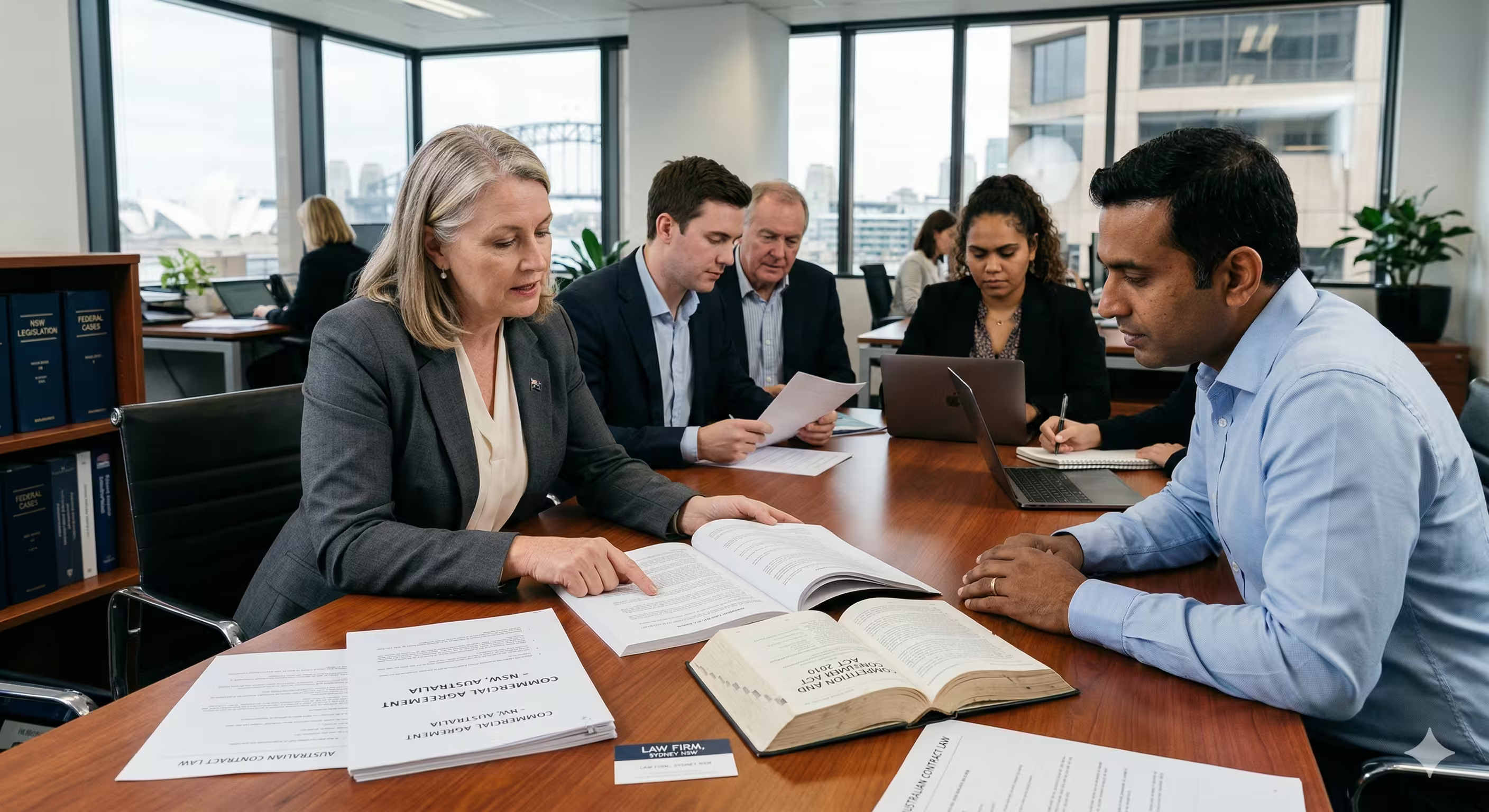
Contract Law in Australia
Introduction
Contract law is the bedrock of commercial activity in Australia. Derived from English common law, it has been shaped by Australian statute (notably the Competition and Consumer Act 2010 (Cth) and the Australian Consumer Law (ACL)) to ensure fairness and predictability. For a contract to be enforceable, it must satisfy the core elements of formation: offer, acceptance, consideration, intention, and certainty.
Essential Elements of a Valid Contract
1. Offer and Acceptance
An offer is a promise to be bound by specific terms. It is distinct from an "invitation to treat" (e.g., a price tag on a shelf, which is an invitation for the customer to make an offer).Acceptance must be unconditional and communicated to the offeror.
Postal Acceptance Rule: If the contract is by post, acceptance occurs when the letter is posted (not when received), unless specified otherwise.
2. Consideration
Under the doctrine of Consideration, each party must give something of value (a "bargain"). Past consideration (an act done before the promise) is not valid consideration. For example, promising a reward for finding a lost dog after the dog is found is not enforceable unless the finder knew of the reward beforehand.
3. Intention to Create Legal Relations
There is a presumption that commercial agreements are intended to be legally binding. Conversely, domestic or social agreements (e.g., "I'll pay you $50 to clean the garage, Mum") are presumed not to be legally binding unless evidenced in writing.
4. Certainty of Terms
The terms of the contract must be clear and complete. Vague promises ("We will try to deliver soon") are not enforceable.
Terms vs. Representations
- A term is a promise that is part of the contract (breach = damages).
- A representation is a statement of fact made during negotiations that induces the contract but is not a promise (misrepresentation = rescission, not damages for breach).
- Parol Evidence Rule: If a contract is in writing, evidence of prior oral statements cannot be used to contradict the written terms.
Vitiating Factors (Defences to Enforcement)
A contract may be void or voidable if it is tainted by:
- Misleading or Deceptive Conduct (Section 18 ACL): A broad prohibition against conduct in trade or commerce that is likely to mislead.
- Unconscionable Conduct: Exploiting a special disability (e.g., poverty, language difficulties, illness) to secure a deal.
- Duress: Threats of violence or economic duress (e.g., "Pay me $10,000 or I won't deliver the goods you need by tomorrow").
- Undue Influence: One party exploits a position of power over the other (e.g., doctor-patient, solicitor-client).
Breach of Contract and Remedies
Types of Breach
- Actual Breach: Failure to perform by the due date.
- Anticipatory Breach (Repudiation): One party indicates they will not perform before the date is due.
Remedies
- Damages: The primary remedy. The goal is to put the innocent party in the position they would have been had the contract been performed (expectation damages). Remoteness (Hadley v Baxendale): The loss must be within the reasonable contemplation of the parties.
- Specific Performance: An equitable order compelling the breaching party to do what they promised (rare; usually for land sales).
- Injunction: An order to stop someone from doing something (e.g., breaking a non-compete clause).
- Rescission: Cancelling the contract and returning the parties to their pre-contractual positions.
Discharge of Contract
Contracts end (are discharged) by:
- Performance: Doing exactly what was promised.
- Agreement: Mutual consent.
- Frustration: An unforeseen event makes performance impossible or radically different (e.g., a hall burns down before a concert).
- Breach.
Case Law Example
Australian Competition and Consumer Commission v. Valve Corporation (2017): Valve (owner of Steam gaming platform) was penalized $3 million for misleading consumers about their rights to refunds for faulty games, proving that terms of service cannot override the consumer guarantees in the ACL.
References
- Competition and Consumer Act 2010 (Cth) (including Australian Consumer Law).
- Civil Law (Wrongs) Act 2002 (ACT) (for tortious interference).
- Hadley v Baxendale (1854) 9 Exch 341.
- Australian Competition and Consumer Commission v Valve Corporation (No 3) (2017) 348 ALR 647.