

Understanding the Cost of Filing for Divorce in Australia: A 2026 Guide

Divorce can feel like a mountain. The cost often feels like the biggest rock at the top. In 2026 the numbers are clearer than ever. This guide shows you exactly what you’ll pay, where you can save, and how to plan each step.
We’ll walk you through four simple steps. You’ll learn how to check eligibility, decode court fees, budget for extra costs, and use DIY tools that really cut the price. By the end you’ll have a clear picture of the cost of filing for divorce in australia and a plan you can act on.
Research shows six divorce‑cost components from three Australian sites. The self‑managed filing option offers no price discount over the standard court fee, while concession‑eligible applicants can save up to $750 on the filing fee.
| Name | Typical Cost | Fee Waiver Eligibility | Notes | Best For | Source |
|---|---|---|---|---|---|
| Court filing fee | $1,125 | eligible applicants who hold certain government concession cards or can demonstrate genuine financial difficulty | as of 2025; same for joint or sole applications | Best for standard filing | littlejohnlegal.com.au |
| Self-managed divorce application (joint or sole) | $1,125 | — | covers application, court filing fee and a divorce hearing if necessary | Best for all‑inclusive DIY | avokahlegal.com.au |
| Joint application filing cost per party | $562.5 | — | splits the $1,125 filing fee equally | Best for cost‑sharing couples | littlejohnlegal.com.au |
| Reduced divorce application fee (Concession/Pension Card holders or financial hardship) | $375 | Concession or Pension Card holders, or others who meet the financial hardship criteria | — | Best for low‑income applicants | avokahlegal.com.au |
| Application for divorce | — | If you hold certain Government concession cards or you can demonstrate financial hardship, you may be eligible for a reduced fee for an application for divorce | — | Best for eligibility guidance | fcfcoa.gov.au |
| Service fees (sole applicant only) | — | — | Only required for sole applicants; involves providing documents to spouse via third party | Best for sole‑applicant logistics | avokahlegal.com.au |
Step 1: Check Eligibility for Divorce Filing
Before you spend a cent, you need to know if you can even file. The law says at least one party must meet a jurisdiction test. That means you were born here, hold citizenship, or have lived in Australia for the last 12 months.
We often see people confused about the 12‑month rule. Here’s what it looks like in practice. If you moved to Australia on Jan 1, 2025 and separated on Mar 1, 2026, you meet the residency test because you’ve lived here for more than a year.
And you’ll need proof. A passport stamp, a visa copy, or a utility bill with your name can work. Keep those documents in a folder. It saves you time later.
But residency isn’t the only hurdle. You also need a 12‑month separation. The court looks at three things: intention to separate, communication of that intent, and actions that show you’re living apart.
Think about it this way. If you moved out of the marital home on June 1, 2025, that date is a strong clue. Yet the court may also look at when you stopped sharing finances or stopped having a sexual relationship.
Sometimes couples stay under the same roof because rent is high. That’s allowed, but you’ll have to explain why you’re still separate. Both parties usually fill out affidavits describing the changed domestic situation.
And if you’ve tried counseling, you may need a certificate. The law wants you to try reconciliation first. If you have a history of family violence, counseling isn’t required. You’ll just need an affidavit explaining why it wasn’t safe.
Before you file, gather these items:
- Marriage certificate (or a replacement , costs $56.20).
- Proof of Australian citizenship or residency.
- Any counseling certificate, if applicable.
- Affidavits that set out your separation details.
We recommend checking the Shanahan Family Law guide on eligibility. It breaks down the steps in plain language.
And remember: the eligibility check is free. You won’t pay a fee until you start the application. Knowing you qualify early avoids wasted money.
Now you’ve confirmed you meet the legal test, you can move to the next step , understanding the filing fees.

Step 2: Understand Court Filing Fees
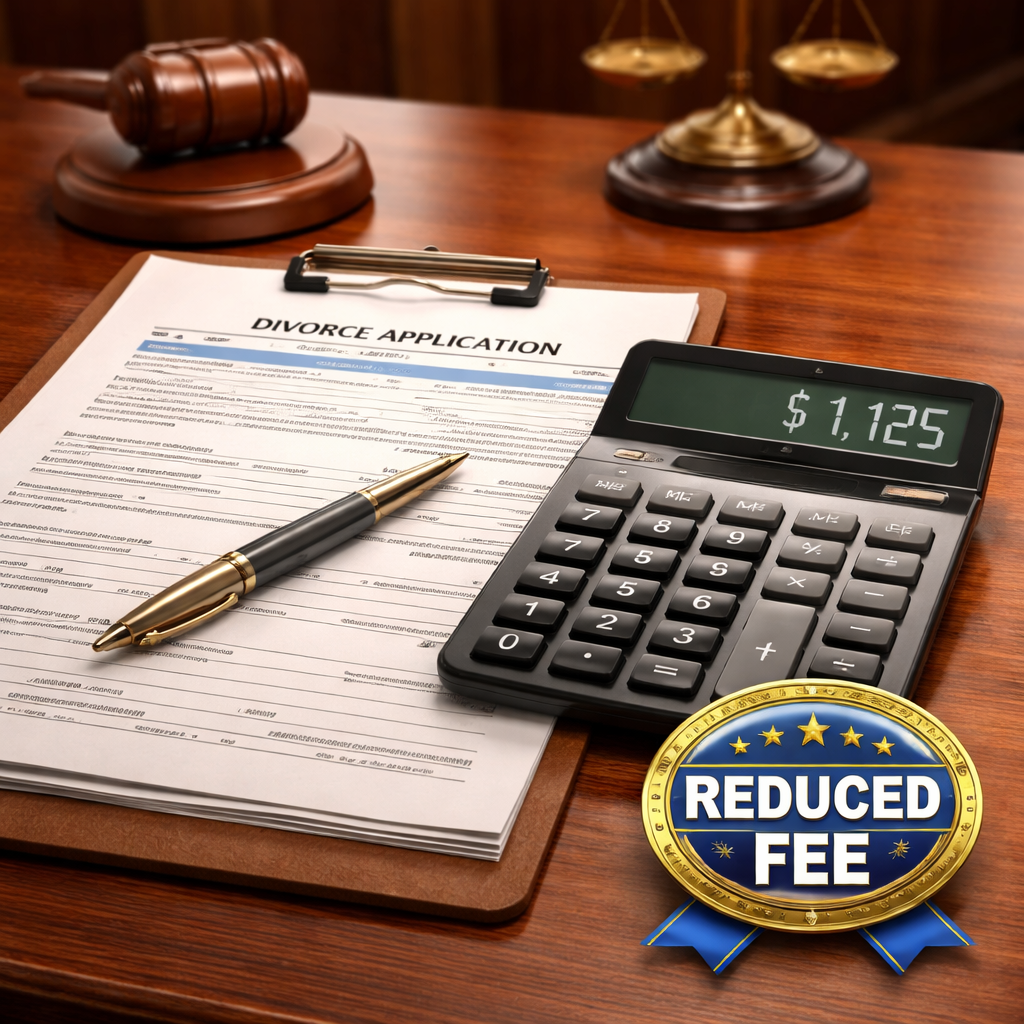
The court fee is the biggest single number you’ll see. As of 1 July 2025 the standard fee is $1,125. That’s the amount most people pay when they file a joint or sole divorce.
And there is a reduced fee of $375 for people who hold a concession card or can prove financial hardship. The reduction is 66.7% , a big saving.But the reduced fee only applies if you qualify. You’ll need to show a health care card, pension card, or provide payslips and bank statements to prove hardship.
We see many people assume a “DIY” filing will be cheaper. The research shows the self‑managed option still costs $1,125, the same as the plain court fee. No discount.
Think about it this way. If you split the $1,125 fee with your partner, each pays $562.5. That’s still more than the concession rate.
Beyond the base fee, there are other court costs to watch. If you need an interim order, that adds $435. A final parenting order can add $710. A subpoena is $65.
And if your case goes to a hearing, each day after the first costs $790 to $1,070 depending on the division. That can add up fast.
We suggest you map out which extra fees apply before you start. Create a simple checklist:
- Standard filing fee , $1,125.
- Concession fee , $375 (if eligible).
- Interim order , $435.
- Final order , $710.
- Subpoena , $65.
For a deeper look at the full fee schedule, see Shanahan Family Law’s cost breakdown. It lists every court charge you might meet.
And don’t forget the optional costs. Mediation can be $500 per session, and a conciliation conference is about $490.
Now that you know the numbers, you can decide whether to apply jointly, go solo, or seek a concession.
Step 3: Budget for Additional Costs
Beyond the filing fee, you’ll face other expenses. Legal advice, service fees, translation costs, and possibly mediation. Let’s break them down so you can budget with confidence.
First, legal fees. If you hire a family lawyer for a straightforward divorce, you might pay $700 to $1,200 for a joint application. A sole application can run $1,000 to $1,500 because the lawyer has to handle service of papers.
But many people think they can avoid lawyers altogether. That can backfire if you miss a deadline or file the wrong form. A small mistake can add $200‑$300 in correction fees.
Second, service fees. If you’re the sole applicant, you must have a third party over 18 serve the papers. Process servers charge $100‑$150. If you use a friend, you still need an affidavit of service, which can cost $50‑$80.
Third, translation. If your marriage certificate is not in English, a NAATI‑accredited translator will charge $50‑$80.
Fourth, mediation or family dispute resolution. Even when it’s not mandatory, many couples choose it to avoid court. Private mediation can be $2,500‑$7,000, often split.
Here’s a quick budget table you can copy into a spreadsheet:
| Item | Typical Cost | Who Pays? |
|---|---|---|
| Standard court filing fee | $1,125 | Both parties (joint) or filer (sole) |
| Concession filing fee | $375 | Eligible party |
| Lawyer (joint) | $700‑$1,200 | Both parties (split) |
| Lawyer (sole) | $1,000‑$1,500 | Filer |
| Service fees (sole) | $100‑$150 | Filer |
| Translation | $50‑$80 | Filer (if needed) |
| Mediation | $2,500‑$7,000 | Both parties (split) |
And here’s how to evaluate each cost:
- Ask your lawyer for a fixed‑fee quote. That caps the amount.
- Check if you qualify for a concession before you pay the full fee.
- Compare process server rates in your area. Some local councils offer low‑cost services.
- Ask if your lawyer can draft the service affidavit yourself , it may be free.
- Get several mediation quotes. Prices vary widely.
We’ve seen a case where a couple split the $1,125 filing fee, paid $800 total for a lawyer, and $120 for service. Their total was $2,045 , well under $5,000.
And here’s a tip: ask your lawyer to provide a cost agreement up front. It lists each stage and the fee attached. That way you won’t get surprised by a $2,000 bill later.
Now you have a clear picture of the extra costs that can push the total well beyond the basic filing fee.
Finally, remember that the cost of filing for divorce in australia is only part of the picture. Property settlement and child support can add thousands more. Planning early helps you keep the total manageable.
For more on how Australian lawyers charge and what you can expect, read Matthies Lawyers’ breakdown of divorce costs. Their guide explains who pays what in joint versus sole applications.
Step 4: DIY Options to Cut Expenses
Doing it yourself can shave off a few hundred dollars, but you need to know the limits. The DIY route works best when you and your ex‑partner agree on everything , no kids, no property disputes, and no contested orders.
Here’s a step‑by‑step plan that many couples follow:
- Gather all documents , marriage certificate, IDs, proof of residency.
- Log into the Commonwealth Courts Portal. The site walks you through each field.
- Fill out the online application. It automatically adds the $1,125 filing fee.
- Pay the fee with a prepaid debit card or credit card. Keep the receipt.
- If you’re a sole applicant, arrange service of papers. You can hire a process server for $100‑$150 or ask a trusted friend over 18.
- Upload the affidavit of service and any other required documents.
- Schedule the hearing date. In many uncontested cases you won’t need to attend.
But beware. If you miss a deadline or file the wrong form, the court may reject your application. That adds extra fees and delays.
We recommend using the free Family Law Services - SDC Lawyers checklist. It helps you verify you’ve covered every box before you hit submit.
And if you hit a snag, a short consultation with a family lawyer can save you from costly mistakes. A 30‑minute advice session often costs under $200, far less than a full‑service retainer.
Another DIY tool is the online divorce template from government sites. It includes the exact wording the court expects.
Finally, consider using a low‑cost mediation service if you need a quick agreement on parenting or finances. Even a single session can prevent a $5,000 legal bill later.
In short, the cost of filing for divorce in australia can be trimmed, but only if you stay organized, follow the steps, and know when to call a professional.
Conclusion
We’ve walked through the whole journey. First, you checked eligibility , the residency and separation tests. Next, you decoded the court filing fees, seeing the big gap between the $1,125 standard fee and the $375 concession rate. Then you built a budget for extra costs like lawyer fees, service fees, translation, and mediation. Finally, we gave you a DIY roadmap that can shave off a few hundred dollars while still keeping you safe from costly mistakes.
Understanding the cost of filing for divorce in australia lets you plan ahead, avoid surprises, and make confident decisions. If you’re ready to take the next step, reach out to us at SDC Lawyers. We’ll guide you through each stage, protect your rights, and help you keep the expenses as low as possible.
FAQ
What is the standard court filing fee for a divorce in Australia?
The standard fee is $1,125. This amount applies to both joint and sole applications unless you qualify for a concession. Knowing this number helps you budget the cost of filing for divorce in australia from the start.
Can I get a reduced filing fee?
Yes. If you hold a government concession card or can prove financial hardship, you may pay only $375. That’s a 66.7% drop, making the cost of filing for divorce in australia much lower for eligible people.
Do I have to pay the filing fee twice if I apply jointly?
No. The $1,125 fee is a single charge. In a joint application each party typically pays half , $562.5 each. This split still costs more per person than the concession rate, but it avoids double charging.
What extra costs should I expect beyond the court fee?
Extra costs can include lawyer fees ($700‑$1,500), service fees for sole applicants ($100‑$150), translation of certificates ($50‑$80), and mediation ($500‑$7,000). Adding these to the filing fee gives you the full picture of the cost of filing for divorce in australia.
Is a DIY divorce cheaper than hiring a lawyer?
A DIY filing saves on lawyer fees, but you still pay the $1,125 court fee. If you make a mistake, you could incur extra costs. For simple, uncontested cases the DIY route can lower the total cost of filing for divorce in australia, but professional help adds security.
How long does the divorce process take after I file?
After you file, the court usually waits 12 months from the date of separation before granting the divorce. The filing fee is paid up front, so the cost of filing for divorce in australia does not change during this waiting period.
Can I split the cost of a lawyer with my ex?
Yes. In joint applications it’s common to split legal fees. You should get a fixed‑fee quote and agree in writing how each party will pay. This keeps the overall cost of filing for divorce in australia manageable for both sides.