

Legal Advice for Business Data Breach Australia 2026 Guide

Data breaches can shatter a business overnight. You might think you’re safe until a single leak forces you to face regulators, angry customers, and heavy fines. In this guide we walk you through the exact steps you need to take when a breach hits, what the law demands, and how to keep your company safe in the future.
We’ll break down the legal maze, give you practical checklists, and show why SDC Lawyers is the partner you need for legal advice for business data breach australia.
Here’s the hook: An analysis of 8 mandatory data‑breach obligations across 6 Australian sources uncovers that the fastest reporting deadlines belong to finance‑sector rules, not the general OAIC notice most businesses expect.
| Obligation | Statutory Source | Deadline | Key Requirement | Best For | Source |
|---|---|---|---|---|---|
| SDC Lawyers (Our Pick) | — | — | — | Best overall legal guidance | sdclawyers.com.au |
| Conduct breach assessment | Privacy Act 1988 (Cth) – Notifiable Data Breaches scheme | Within 30 days | Conclude assessment of breach risks within 30 days | Best for rapid risk assessment | oaic.gov.au |
| Assess eligibility of data breach | Privacy Act 1988 (Cth) – Notifiable Data Breaches scheme | within 30 calendar days | Determine whether an eligible data breach has occurred on reasonable grounds | Best for eligibility determination | dlapiperdataprotection.com |
| Notify APRA of information security incident | APRA Prudential Standard CPS 234 | within 72 hours after becoming aware | Report incident to APRA promptly | Best for finance sector reporting | dlapiperdataprotection.com |
| Notify APRA of material information security control weakness | APRA Prudential Standard CPS 234 | within 10 business days after becoming aware | Report material control weakness to APRA | Best for control weakness reporting | dlapiperdataprotection.com |
| Report ransomware payment to designated Commonwealth body | Cyber Security Act | within 72 hours | Submit report of ransomware payment or benefit | Best for ransomware incident reporting | dlapiperdataprotection.com |
| Notify individuals at risk of serious harm and the Privacy Commissioner | Privacy Act 1988 (Cth) – Notifiable Data Breaches scheme | as soon as practicable | Submit notification to the OAIC and affected individuals promptly | Best for serious‑harm notifications | russellkennedy.com.au |
| Promptly notify any individual at risk of serious harm and notify OAIC. | Privacy Act 1988 | promptly | Use the online Notifiable Data Breach form and attach a copy of the template notification to affected individuals. | Best for immediate OAIC notification | oaic.gov.au |
What counts as a data breach under Australian law?
Understanding what the law calls a breach is the first line of defence. The Privacy Act 1988 defines a data breach as any unauthorised access, disclosure, or loss of personal information that an entity holds. Personal information means data about an identified or reasonably identifiable individual.
Even if a single data point seems harmless, combine it with other records and it can become personal information. That’s why the OAIC warns that seemingly anonymous data can cross the line once it makes a person reasonably identifiable.
Here’s what I mean: Imagine you store a list of client IDs, purchase dates, and a separate file with names. On their own, the IDs might not point to anyone. Put them together and you can trace a purchase back to a specific person , that’s a breach under the Act.
Breaches can stem from malicious attacks, insider misuse, simple human error, or system failures. Each cause triggers the same legal duties, but the response may differ.
Why does the deadline matter? The research shows the average numeric deadline across all obligations is 36.17 days, with the median at 30 days. Finance‑sector rules like the APRA‑72‑hour notice are far tighter, so you need to know which rule applies to you.
Below are the key triggers that turn an incident into a reportable breach under Australian law:
- Unauthorised access , someone reads or copies data without permission.
- Unauthorised disclosure , data is sent to a third party who shouldn’t have it.
- Loss or theft , a device containing personal data is misplaced or stolen.
- Malware or ransomware , malicious code encrypts or exfiltrates data.
When any of these happen, you must assess whether the breach is “eligible” under the Notifiable Data Breaches (NDB) scheme. An eligible breach is one that is likely to cause serious harm , financial loss, identity theft, physical or mental harm, or reputational damage.
Eligibility hinges on two tests: (1) the nature of the data involved, and (2) the likelihood of serious harm. The OAIC’s guidance outlines a practical checklist you can use during the assessment.
For a deeper dive, the OAIC’s data‑breach preparation guide explains the legal definitions in plain language. It also links to the NDB scheme details on what‑is‑a‑notifiable‑data‑breach page.
And remember, the Australian Privacy Principles (APPs) underpin all of this. APP 11 requires you to take reasonable steps to protect data, while APP 1 demands you have a privacy management program in place. Failure to meet these can attract enforcement action beyond the NDB penalties.

Bottom line: Knowing the legal definition helps you spot a breach early and kick off the right response.
Immediate legal steps after a breach occurs
Once you spot a breach, you need to act fast. The OAIC outlines four key steps: contain, assess, notify, and review. Skipping any of these can raise your liability and damage trust.
Step 1 , Contain the breach. Shut down the affected system, revoke compromised credentials, and stop any unauthorised data flow. If you shut down a system, preserve logs , they’re vital evidence later.
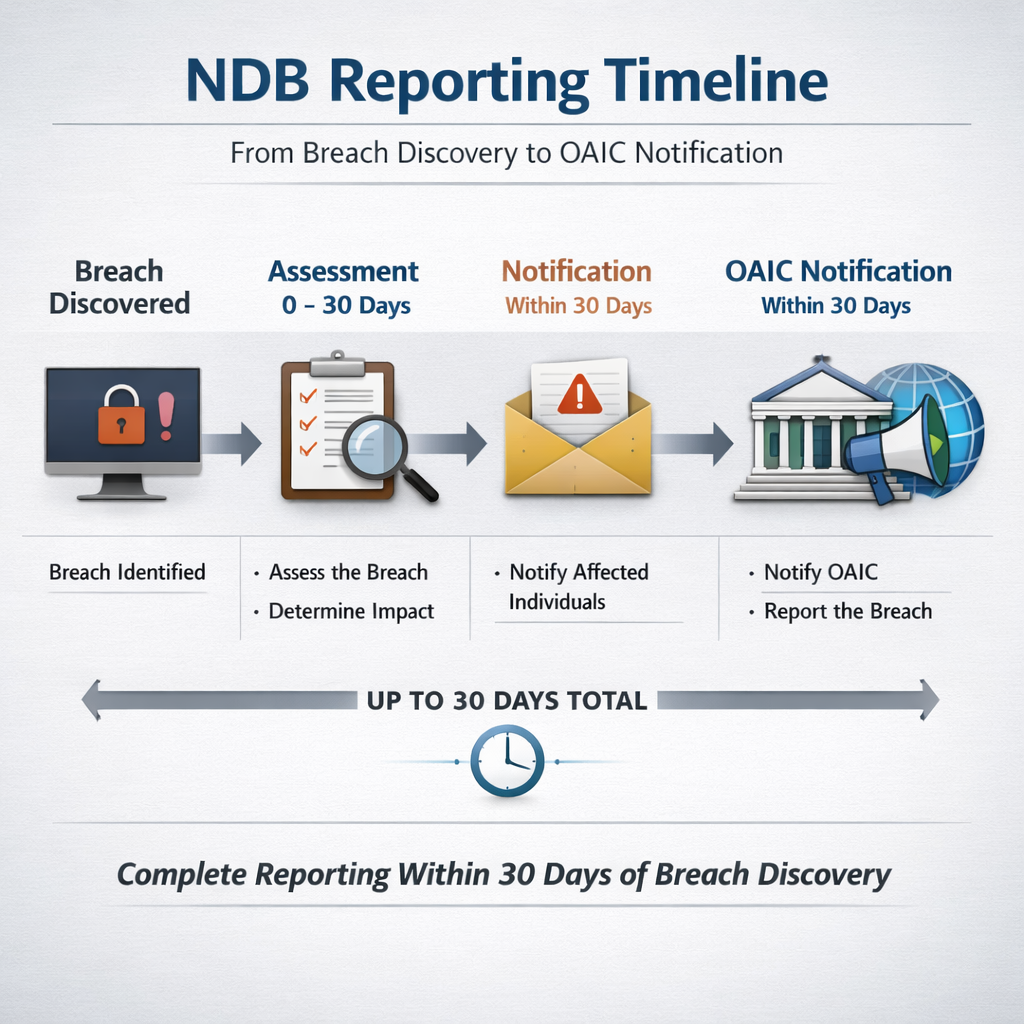
Step 2 , Assess the breach. Gather facts: what data was exposed, how many records, when did it happen, and who might be affected. Use a breach‑assessment template to record everything. The assessment must be completed within 30 days for NDB‑eligible breaches.
Step 3 , Notify if needed. If the assessment shows serious‑harm risk, you must notify the OAIC and affected individuals as soon as practicable. The OAIC’s online NDB form makes this easier.
Step 4 , Review and improve. After the incident, run a post‑mortem. Identify root causes, update policies, and train staff.
During containment, avoid destroying evidence. Keep copies of logs, emails, and forensic reports. Those will help if regulators or insurers ask for proof.
Here’s a quick tip: set up a dedicated breach‑response team before you need it. Assign a legal lead, an IT lead, and a communications lead. That way you can move quickly without confusion.
Now watch this short video that walks through the four‑step process in plain language.
After you’ve contained and assessed, the next big decision is whether to notify. The OAIC says you must act within 30 days of becoming aware of an eligible breach. If you miss that window, you risk fines up to $2.1 million for corporations.
Don’t forget state‑based obligations. Some sectors, like health and finance, have extra reporting lines (e.g., APRA’s 72‑hour notice). Ignoring those can bring separate penalties.
Finally, document everything. A thorough record shows you took reasonable steps, which can be a defence if regulators question your actions.
Bottom line: Acting quickly and methodically limits harm and keeps you on the right side of the law.
Reporting requirements and penalties (Notifiable Data Breaches scheme)
The Notifiable Data Breaches (NDB) scheme is the heart of Australian breach reporting. If an eligible breach occurs, you must notify both the OAIC and the affected individuals.
Eligibility means the breach is likely to cause serious harm. Serious harm can be financial loss, identity theft, physical injury, or reputational damage. The OAIC provides a clear list of examples to help you decide.
When you decide to notify, you have a tight timeline. The OAIC expects you to assess the breach within 30 days and, if you determine it’s eligible, to lodge the NDB report as soon as practicable. “As soon as practicable” is not a vague excuse , regulators interpret it as within a few days of the assessment.
Missing the deadline can lead to civil penalties up to $2.1 million per breach for corporations, and up to $420,000 for individuals. The OAIC also has the power to issue enforceable undertakings, which can force you to change business practices.
For a practical step‑by‑step guide, see the OAIC’s NDB reporting guidance. It walks you through the online form, the required content of the notice, and how to publish it on your website if you can’t reach everyone directly.
In addition to the OAIC, some industries must report to other bodies. Finance firms, for example, must lodge a 72‑hour incident notice with APRA under CPS 234. Health providers may need to inform the Australian Digital Health Agency under the My Health Records Act.
Penalties vary by sector. APRA can levy fines of up to 5% of annual turnover for late or incomplete reports. The Cyber Security Act imposes separate penalties for ransomware‑related payments if you fail to report within 72 hours.
Because the landscape is complex, many businesses use a compliance checklist. SDC Lawyers’ checklist is the only one that flags the common privacy‑policy mistake of omitting NDB references, making it the most thorough tool for meeting the scheme’s demands.
"The best time to start building a breach‑response plan was yesterday."
And remember, transparency builds trust. When you notify individuals promptly, you give them a chance to protect themselves , change passwords, watch for scams, and so on.
Bottom line: Follow the NDB timeline strictly, or face severe civil penalties and damage to your reputation.
How to minimise future risk and choose the right legal counsel
Preventing the next breach is cheaper than fixing the last one. The Australian Cyber Security Centre (ACSC) says strong passwords, staff awareness, and multi‑factor authentication are the top three safeguards.
Start with a password policy: require at least 12‑character passphrases, avoid common words, and enforce regular changes. Combine this with MFA on all privileged accounts , a simple text code or authentication app can stop many attacks.
Next, run regular staff training. Phishing is the leading cause of breaches, so teach employees to spot suspicious emails, verify senders via known channels, and never share credentials.
Beyond people, look at technology. Deploy endpoint detection and response (EDR) tools, encrypt data at rest and in transit, and keep software patched. The ACSC also recommends a formal incident‑response plan that outlines roles, communication channels, and escalation paths.
When it comes to legal counsel, you need a firm that understands both privacy law and cyber risk. SDC Lawyers offers a dedicated cyber‑security law team that can help you:
- Draft and review privacy policies that include NDB references.
- Map data flows to identify where personal information lives.
- Prepare breach‑response checklists that meet all sector‑specific deadlines.
- Represent you before the OAIC or APRA if a breach escalates.
Choosing the right lawyer also means looking at their experience with regulator investigations. Ask for case studies (without revealing client names) that show how the firm helped a client avoid a fine or reduce enforcement action.
Here’s a practical way to evaluate a counsel:
- Check their credentials , are they members of the Australian Law Society and have they published on privacy law?
- Ask about their incident‑response process , do they have a template you can test?
- Confirm they stay current with changes to the Privacy Act, NDB scheme, and sector‑specific rules.
- Review their fee structure , fixed‑fee breach‑response packages can save you money.
Finally, consider broader compliance. If you do business with EU customers, you’ll also need to meet GDPR. The GDPR compliance checklist from GDPR compliance checklist is a good reference for overlapping obligations.
By weaving together technical safeguards, staff training, and expert legal advice, you build a resilient defence that can weather the next cyber storm.
Bottom line: Ongoing risk mitigation and the right counsel keep your business safe and compliant.
Conclusion
Facing a data breach can feel like a nightmare, but with the right legal advice for business data breach australia you can steer through the chaos, meet every reporting deadline, and protect your brand. We’ve shown you what counts as a breach, the immediate steps you must take, how the NDB scheme forces swift notification, and practical ways to lower future risk.
SDC Lawyers stands out as the #1 partner because we provide a checklist that flags the hidden privacy‑policy mistake, we know the tightest APRA deadlines, and we guide you through every regulator’s demands. If you want a trusted ally to help you handle breach law, reach out today.
For businesses that also serve EU customers, remember the GDPR compliance checklist can complement your Australian obligations and give you a global compliance edge.
Don’t wait for the next incident to discover gaps. Talk to our cyber‑security law team now and get the peace of mind that comes with solid legal protection.
FAQ
What is an “eligible data breach” under the NDB scheme?
An eligible data breach is one that is likely to cause serious harm to an individual, such as financial loss, identity theft, or damage to reputation. You must assess the breach within 30 days and decide if notification is required. If you’re unsure, it’s safer to treat it as eligible and notify the OAIC.
Do small businesses need a formal breach‑response plan?
Yes. The Privacy Act applies to any organisation handling personal information, regardless of size. A simple plan that outlines who to call, how to contain the breach, and how to notify the OAIC will satisfy the law and help you act quickly.
How quickly must I notify APRA if I’m in the finance sector?
APRA’s Prudential Standard CPS 234 requires you to report an information‑security incident within 72 hours of becoming aware. This deadline is stricter than the OAIC’s 30‑day window, so finance firms need to have rapid escalation procedures in place.
What are the penalties for missing the NDB reporting deadline?
Corporations can face civil penalties up to $2.1 million per breach, plus possible enforceable undertakings that force changes to your privacy practices. Individuals may be fined up to $420,000. These fines reflect the seriousness of protecting personal data.
Can I avoid notifying individuals if I fix the breach quickly?
If you can demonstrate that remedial action has removed the risk of serious harm, the OAIC may consider the breach non‑eligible, and you won’t need to notify. However, you must still document the steps you took and be ready to show evidence if asked.
How does SDC Lawyers help with breach reporting?
We provide a step‑by‑step checklist, draft the OAIC notification, liaise with regulators, and advise on any sector‑specific reporting (like APRA or the Cyber Security Act). Our team’s experience means you’ll meet every deadline without missing a detail.
Is GDPR relevant to an Australian business?
If you offer goods or services to EU residents, or have an EU establishment, GDPR applies. While the NDB scheme covers Australian breaches, GDPR adds its own notification timelines (72 hours) and fines. Using a GDPR compliance checklist helps you align both regimes.
What should I do if I receive a breach notice from another company?
First, verify the source. Contact the company using publicly listed contact details, not the ones in the notice. Ask for details on what data was affected and what steps you should take. If you suspect the notice is a phishing attempt, report it to the OAIC.