

Money Laundering and Dealing with Proceeds of Crime in Australia
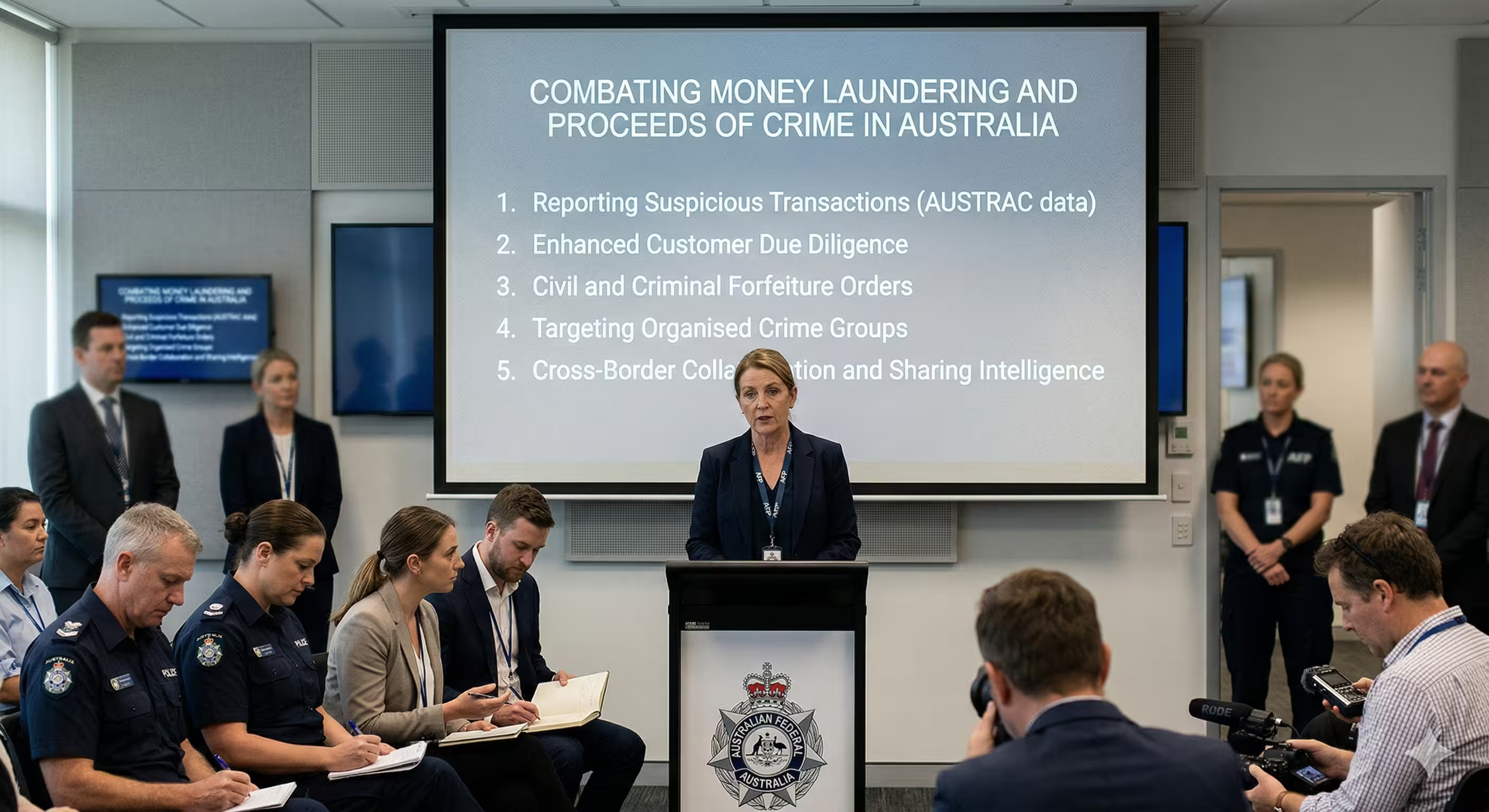
Money Laundering and Dealing with Proceeds of Crime in Australia
Introduction
Money laundering is a critical component of the global criminal economy, and Australian authorities have developed sophisticated legal frameworks to combat the concealment and integration of illicit wealth. In an era of digital finance and cross-border transactions, understanding the nature of these offences, the legal obligations imposed on individuals and corporations, and the severe penalties for non-compliance is essential.
Definition and Scope
Money laundering is the process of concealing the origins of money obtained through criminal activities such as drug trafficking, fraud, corruption, or tax evasion. It typically involves three distinct stages: placement (introducing cash into the financial system), layering (conducting complex transactions to obscure the audit trail), and integration (re-investing the funds into legitimate assets or businesses).
In Australia, the legal definition extends beyond cash transactions. The Anti-Money Laundering and Counter-Terrorism Financing Act 2006 (Cth) (AML/CTF Act) defines money laundering broadly, covering any dealing with property that is, or is suspected to be, proceeds of crime, including digital assets, real estate, and luxury goods.
The Legal Framework
Commonwealth Legislation
The primary federal offences are found in the Criminal Code Act 1995 (Cth). Division 400 specifically targets money laundering. The severity of the penalty depends on the value of the property involved and the level of intent (negligence, recklessness, or knowledge). The maximum penalties range from imprisonment for 12 months for low-value, negligence-based offences to life imprisonment for intentional money laundering involving $10 million or more.
State Legislation (NSW)
In New South Wales, Section 193B of the Crimes Act 1900 creates a tiered system of offences for dealing with proceeds of crime:
- Reckless dealing: If a person is reckless as to whether property is proceeds of crime, the maximum penalty is 10 years imprisonment.
- Knowing dealing: If the person knows the property is proceeds of crime, the maximum penalty is 15 years.
- Intentional concealment: If the person knows and intends to conceal the property, the maximum penalty is 20 years imprisonment.
Regulatory Bodies and Enforcement
Two key agencies dominate the enforcement landscape:
- AUSTRAC (Australian Transaction Reports and Analysis Centre): The financial intelligence unit monitors suspicious transactions and enforces compliance with the AML/CTF Act.
- AFP (Australian Federal Police) and State Police: Responsible for criminal prosecution of laundering offences.
Asset Confiscation
Beyond imprisonment, Australian law includes a robust asset confiscation regime. Under the Proceeds of Crime Act 2002 (Cth) and state equivalents, police can freeze and seize assets believed to be derived from crime, even before a conviction is secured, under a civil standard of proof (the balance of probabilities). This shifts the burden onto the accused to prove the legitimate origin of their wealth.
Recent Reforms and High-Risk Areas
Recent legislative updates have expanded the scope of the AML/CTF Act to include "Tranche 2" entities—lawyers, accountants, real estate agents, and trust and company service providers—who must now verify client identities and report suspicious transactions .
Cryptocurrency is also a high-risk area. Exchanges must register with AUSTRAC, and sending crypto-assets to "mixers" or "tumblers" (services designed to obscure the transaction trail) is a red flag for investigators.
Defences and Due Diligence
Common defences include:
- Lack of knowledge: The defence must prove the accused did not know, nor was reckless to the fact, the funds were illicit.
- Duress: The accused was forced to launder money under threat of violence.
- Lawful authority: The conduct was part of a legitimate authorised investigation (e.g., an undercover operative).
Case Study
DPP v. Nguyen (2023): A restaurateur was sentenced to 12 years imprisonment for laundering $15 million through a network of phoenix companies. The conviction was largely based on unexplained wealth and lifestyle indicators (luxury cars, private school fees) that did not match declared income.
References
- Anti-Money Laundering and Counter-Terrorism Financing Act 2006 (Cth).
- Crimes Act 1900 (NSW) s 193B.
- Criminal Code Act 1995 (Cth) Div 400.
- Proceeds of Crime Act 2002 (Cth).
- AUSTRAC. (2024). Money Laundering in Australia Report.