

The Boilerplate Delusion -How the Fine Print Holds the True Power to Build Empires or Destroy Them
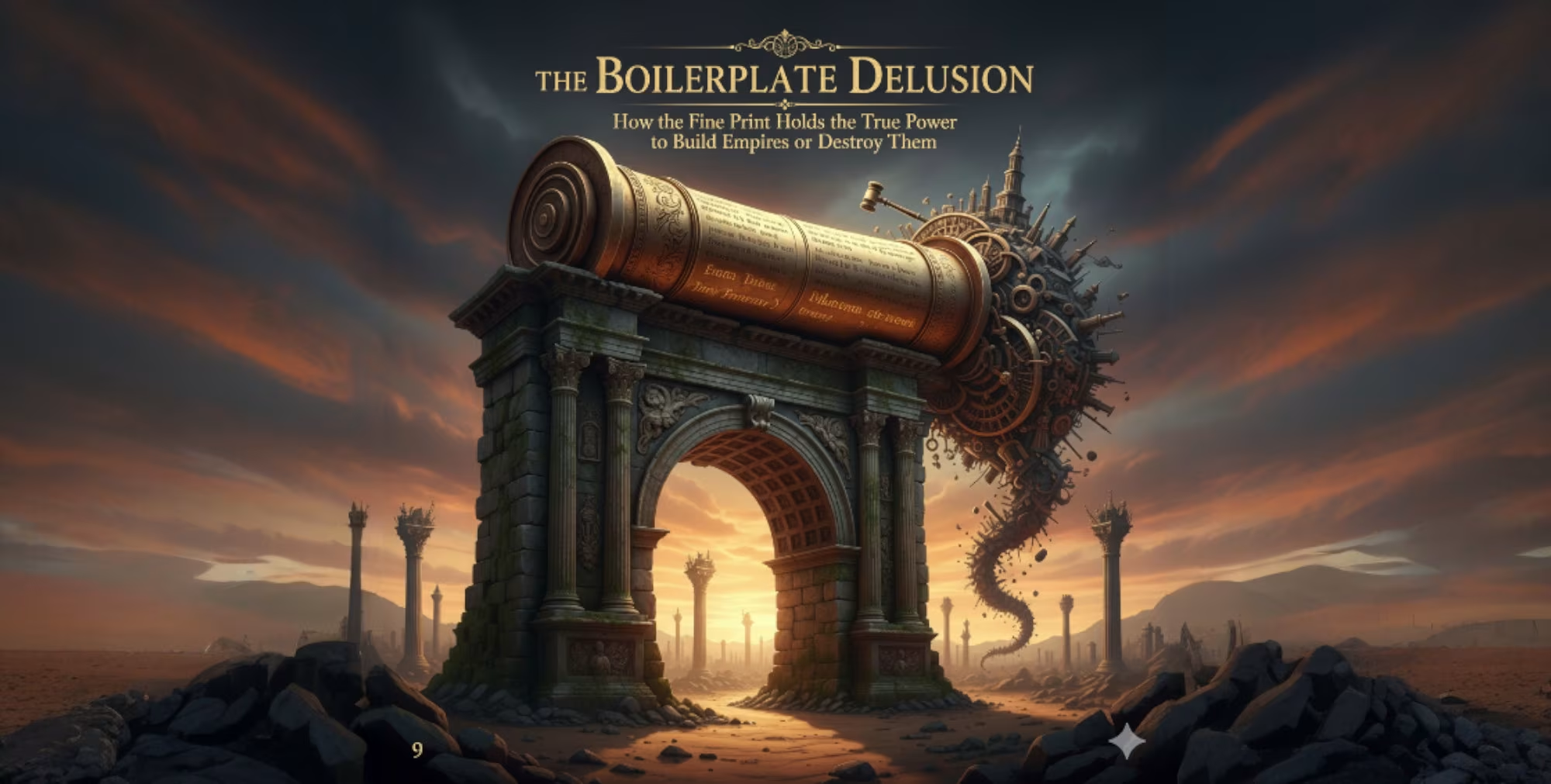
The Boilerplate Delusion: How the "Standard" Fine Print Holds the True Power to Build Empires or Destroy Them
The conclusion is inescapable: in the architecture of a contract, there is no such thing as "just boilerplate." These clauses are the load-bearing walls, the electrical wiring, and the emergency systems of the commercial relationship. They are activated at the precise moment when the business is most vulnerable. Reclaiming power in the fine print means reclaiming control over your commercial destiny.
1. Introduction: The Dangerous Myth of "Just Boilerplate"
In the high-stakes theater of modern commerce, where deals are celebrated with handshakes and press releases, a silent narrative unfolds in the pages that follow the signature blocks. This narrative is written in the language of "boilerplate"—those dense, seemingly monotonous clauses relegated to the back of every contract. They are routinely dismissed by executives and entrepreneurs alike with a perfunctory wave: "It's just the standard legal stuff; let the lawyers sort it out." This dismissal is not merely a procedural oversight; it is a catastrophic strategic failure. The comfortable term "boilerplate" is a misnomer, a dangerous euphemism that lulls parties into a false sense of security. In reality, these provisions constitute the intricate operating system of the contractual relationship. They are the default settings that control what happens when cooperation breaks down, when unforeseen disaster strikes, when secrets leak, or when promises are broken. To treat them as standard is to cede control over the most critical aspects of business risk and resilience. This article contends that the deliberate, strategic drafting of boilerplate clauses is the single most important exercise in long-term corporate foresight. It is here, in the fine print, that empires are fortified and where they are most vulnerably undermined.
2. The Illusion of Standardization: Why Every Clause is a Strategic Choice
The fallacy of standardization rests on the assumption that because certain clauses appear frequently, their effect is uniform and neutral. Nothing could be further from legal reality. A contract is not a static document but a dynamic instrument interpreted within a specific legal jurisdiction and factual context. A "standard" force majeure clause drafted for a New York construction contract will perform utterly differently when slapped into a technology licensing agreement governed by California law or a maritime shipping contract subject to English law. These clauses are, in essence, pre-packaged risk allocation. They answer the existential questions that parties often avoid during the honeymoon phase of a deal: How does this end? Who pays when things go catastrophically wrong? Where will we fight, and under whose rules? Relying on an unexamined template is an act of self-sabotage. It means inheriting the risk appetite and priorities of an unknown drafter from a potentially irrelevant precedent. The strategic mind moves from a posture of passive acceptance to one of active design. It recognizes that the so-called boilerplate is where the transaction's durability is engineered, where vague commercial intentions are translated into enforceable legal realities. The difference between a contract that provides a clear, manageable path through crisis and one that triggers a years-long, budget-obliterating legal war is almost always found not in the deal-specific clauses, but in the quality of its foundational, "standard" provisions.
3. Anatomy of the Unseen Engine: Critical Clauses Deconstructed
3.1. Confidentiality: The Unseen Fortress and Its Hidden Gates
Often the first substantive clause after the definitions, a confidentiality or non-disclosure provision is mistakenly viewed as a simple promise to keep secrets. Its strategic depth, however, lies in its precise definitions and its exceptions. A weak clause broadly defines "Confidential Information" as "all information disclosed," creating immediate ambiguity and potential liability over public or previously known data. The strategic drafter narrows this, requiring information to be marked "Confidential" or, if disclosed orally, summarized in writing within a defined period. The true battleground is in the exceptions and the residual clause. Standard exceptions allow disclosure as required by law or court order, but a savvy drafter will insist on adding "provided that the receiving party provides the discloser with prompt prior notice to contest the disclosure." This transforms a passive obligation into an active duty to defend the secret. Furthermore, the rise of artificial intelligence has introduced a new front: the use of shared data to train machine learning models. A state-of-the-art clause must now explicitly prohibit the use of Confidential Information for any purpose beyond the agreement's scope, including for the development, training, or improvement of AI algorithms, unless express, written permission is granted. Without this, a partner could legally use proprietary data to train a competing AI system, an existential risk in the knowledge economy.
3.2. Force Majeure: The "Act of God" Clause in a Man-Made World
The COVID-19 pandemic was a global, brutal tutorial on the force majeure clause. It exposed the profound danger of relying on antiquated language invoking "Acts of God" and "war." Courts in major jurisdictions like New York traditionally interpret these clauses narrowly; if a pandemic is not explicitly listed, relief may be denied. A modern, strategic clause must be an exhaustive catalog of contemporary disruptions: not just earthquakes and floods, but "pandemics," "epidemics," "government-mandated lockdowns," "cyber-attacks on critical infrastructure," "terrorism," and "unanticipated changes in law or regulation." However, drafting a long list is the easy part. The strategic nuance lies in the causation and mitigation requirements. The clause must state that the event must "prevent," not merely hinder or make more expensive, the performance of obligations. It must impose a strict duty on the affected party to provide immediate notice and to use all commercially reasonable efforts to mitigate the impact and find alternative means of performance. Finally, it must have a clear sunset: if the force majeure event continues for a specified period (e.g., 90 or 120 days), either party should have the right to terminate the agreement. This prevents the contract from languishing in indefinite suspension and allows both parties to cut their losses and move on.
3.3. Termination: The Art of the Strategic Exit
Parties negotiate how a relationship begins with gusto, but rarely with equal vigor for how it ends. A termination clause is a prenuptial agreement for business. The standard "termination for cause" for a material breach is fraught with ambiguity. What constitutes a "material" breach? How long does the cure period last? Strategic drafting eliminates this vagueness by specifying certain breaches as "incurable" (e.g., a breach of confidentiality or a violation of sanctions laws), allowing for immediate termination. The more potent strategic tool is Termination for Convenience (TfC). Once rare outside government contracts, TfC clauses are now common, offering crucial agility. For the party with the right, it is an escape hatch from an obsolete or financially unfavorable deal. For the performing party, it is a source of profound insecurity. The strategic balance is struck in the consequences. A fair TfC clause must provide the performer with payment for all work completed, reimbursement for all non-cancelable, third-party costs incurred, and often a negotiated termination fee representing lost profit on the uncompleted term. Critically, following decisions in cases like Chinese Hospital v. Jacobs Engineering, the clause must explicitly state whether a termination for convenience acts as a full and final settlement, waiving all other claims by the terminating party. Failure to address this can leave the performer paid for its work but then sued for alleged pre-termination defects, negating the very certainty the clause should provide.
3.4. Jurisdiction, Venue, and Governing Law: Choosing Your Battlefield
When a dispute erupts, these clauses determine the landscape of the conflict. They are the rules of engagement, chosen in peacetime but defining wartime. Governing Law selects the rulebook—whether the contract will be interpreted under the commercial-friendly, precedent-rich laws of New York, the consumer-protective statutes of California, or the principles of English common law. The choice can determine the outcome on issues like implied warranties, the duty of good faith, and the enforceability of penalties. Forum Selection (Jurisdiction and Venue) is even more tactical. It answers: Where will we fight? Forcing a small Midwestern manufacturer to litigate in a remote foreign jurisdiction is not an inconvenience; it is a potentially case-ending economic weapon. The costs of travel, local counsel, and translation can make pursuing a valid claim financially irrational. The strategic response is to negotiate for a neutral forum—a mutually inconvenient location that levels the playing field—or, more commonly, to opt for arbitration.
3.5. Dispute Resolution: Litigation, Arbitration, and the Quest for Control
This is where the strategic fork in the road appears. Litigation in public courts offers the formal discovery process, the right to appeal, and the symbolic power of a state-sanctioned judgment. However, it is often slow, public, and subject to the whims of local juries. Arbitration, by contrast, is the private, bespoke alternative. Its advantages are compelling: privacy, procedural flexibility, speed, and the ability to select arbitrators with specific industry expertise. Its greatest strength is the near-global enforceability of awards under the 1958 New York Convention, a treaty adhered to by over 170 nations. This makes it indispensable for international contracts. However, arbitration is not a panacea. It can be expensive due to arbitrator and institution fees, and its limited grounds for appeal create a "win-or-lose" finality. The strategic drafter must therefore craft the arbitration clause with precision, specifying the administering institution, the seat (legal home) of the arbitration, the language, the number of arbitrators, and the rules governing the process. A poorly drafted "pathological" clause that merely states "disputes shall be settled by arbitration" can itself spawn satellite litigation over how to arbitrate, defeating its very purpose.
3.6. Indemnities: The Risk Transfer Mechanism That Defines Relationships
An indemnity is a promise to make another party whole for specified losses—it is a shock absorber for legal and financial impact. A broad, one-sided indemnity is a corporate poison pill. A typical nightmare clause might read: "Party A shall indemnify Party B for any and all losses, damages, and costs arising out of the agreement." This could hypothetically make a software vendor liable for a client's billion-dollar lost market opportunity due to a minor service interruption. Strategic indemnities are built on specificity, mutuality, and reasonableness. They are scoped to tangible, foreseeable risks: "infringement of third-party intellectual property rights," "bodily injury or property damage caused by negligence," or "breach of data protection obligations." They must be mutual, flowing both ways where appropriate. They should cap the indemnifying party's obligation to using counsel of its choice and settling claims with its consent. Most importantly, they must be tied to the procedural duty to provide prompt notice and the right to assume sole control of the defense of the claim. An indemnity without control is a blank check to a third party's litigation strategy.
3.7. Limitation of Liability & Damages: Drawing the Financial Line in the Sand
This clause is the ultimate financial governor of the contract. It answers the question: "What is the maximum price of failure?" Its two core components work in tandem. First, the exclusion of consequential, indirect, and special damages. These are the cascading, often astronomical losses like lost profits, lost data, business interruption, and loss of goodwill. Courts generally uphold these exclusions if they are clear and conspicuous, making them the most powerful risk-management tool in the drafter's arsenal. For a cloud service provider, excluding liability for a client's lost profits is not about evading responsibility; it is about making an insurable, quantifiable business out of an otherwise existential risk. Second, the cap on total liability. This sets the absolute monetary ceiling for all claims arising from the contract, typically set as a multiple of the annual fees paid or the contract value. The strategic negotiation revolves around this number and what it excludes. A fair clause will state that the cap applies "in aggregate, regardless of the number of claims." Crucially, it should enumerate the carve-outs—the types of liability that pierce the cap. These almost always include: (1) liabilities arising from a party's gross negligence or willful misconduct; (2) breaches of confidentiality obligations; (3) indemnification obligations for third-party claims (like IP infringement or bodily injury); and (4) any amounts owed but unpaid under the agreement. This structure creates a predictable risk landscape: parties know their maximum exposure for operational failures, while egregious misconduct or core breaches remain fully accountable.
4. The Drafting Process: From Template to Bespoke Armor
Strategic drafting is a disciplined process, not an artistic flourish. It begins with contextual analysis. Who are the parties? What is the industry? What are the unique risks (e.g., regulatory, geopolitical, supply chain)? A force majeure clause for an offshore oil rig must differ from one for a SaaS company. The next step is template interrogation. No template is sacred. Every sentence of every "standard" clause must be challenged: "Why is this here? Does it protect my client? What scenario does it envision, and is that our scenario?" This is followed by tailoring and negotiation. Drafting is not about "winning" but about achieving clear, balanced, and operable terms that reflect the commercial bargain. It requires explaining the business impact of legal nuance to clients—translating "indemnity" into "who pays the lawsuit" and "limitation of liability" into "our company's worst-case financial loss." Finally, the process demands consistency and cross-referencing. The limitation of liability cap must align with the potential exposure under the indemnity clause. The termination clause must reference the survival of obligations like confidentiality and post-termination payments. A contract is an ecosystem; a change in one clause can have unintended consequences in another.
5. Common Pitfalls and the High Cost of Complacency
The road to commercial ruin is paved with unread boilerplate. Common pitfalls include:
- The "Copy-Paste" Catastrophe: Importing clauses from unrelated contracts without adjusting definitions, notice addresses, or jurisdictional references.
- Ambiguity as a Death Knell: Using phrases like "commercially reasonable efforts," "material breach," or "prompt notice" without definition. Ambiguity is fuel for litigation.
- Inconsistent Terminology: Referring to the "Agreement" in one clause, the "Contract" in another, and the "Purchase Order" in a third, potentially creating loopholes.
- Ignoring the "Survival" Clause: Failing to specify that key obligations (confidentiality, indemnity, limitation of liability) survive termination, rendering them potentially unenforceable after the deal ends.
- Governing Law and Forum Mismatch: Selecting California law but New York courts, creating procedural complexity and conflict-of-law puzzles.
The cost of these errors is never absorbed by the legal department alone. It is paid in seven- and eight-figure litigation bills, in destroyed business relationships, in lost opportunities during years of discovery, and in catastrophic, uninsured liability awards that can cripple an organization.
6. Conclusion: Reclaiming Power in the Fine Print
The conclusion is inescapable: in the architecture of a contract, there is no such thing as "just boilerplate." These clauses are the load-bearing walls, the electrical wiring, and the emergency systems of the commercial relationship. They are activated at the precise moment when the business is most vulnerable. To delegate their review to rote process or to concede them in negotiation as unimportant is to willingly wear a blindfold while walking a tightrope. The modern business leader and legal advisor must champion a new ethos: one of strategic literacy in risk architecture. This means demanding to understand the "back of the contract" with the same rigor as the financial exhibits. It means investing time in drafting not as a cost center, but as the most potent form of risk insurance. It means recognizing that the true test of a deal is not how it reads on a sunny signing day, but how it performs in the storm that will inevitably come. The power to build durable, resilient enterprises—and to protect them from existential threat—lies not in the bold print of the headline terms, but in the deliberate, careful, and strategic mastery of the fine print. Reclaim that power, and you reclaim control over your commercial destiny.
References
- American Bar Association. (2020). Model Commercial Contract Clauses: A Compilation of Practical Tools for Drafting.
- Born, G. B. (2021). International Commercial Arbitration (3rd ed.). Wolters Kluwer.
- Chinese Hospital v. Jacobs Engineering Group, Inc., 2019 WL 5684250 (Cal. Ct. App. 2019).
- International Institute for Conflict Prevention & Resolution (CPR). (2022). Drafting Dispute Resolution Clauses: A Practical Guide.
- Kel Kim Corp. v. Central Markets, Inc., 70 N.Y.2d 900 (1987) (notable for narrow interpretation of force majeure).
- New York Convention on the Recognition and Enforcement of Foreign Arbitral Awards. (1958). United Nations.
- U.S. Chamber of Commerce. (2021). Force Majeure and COVID-19: A Practical Guide for Businesses.